
Disease Risk Forecast
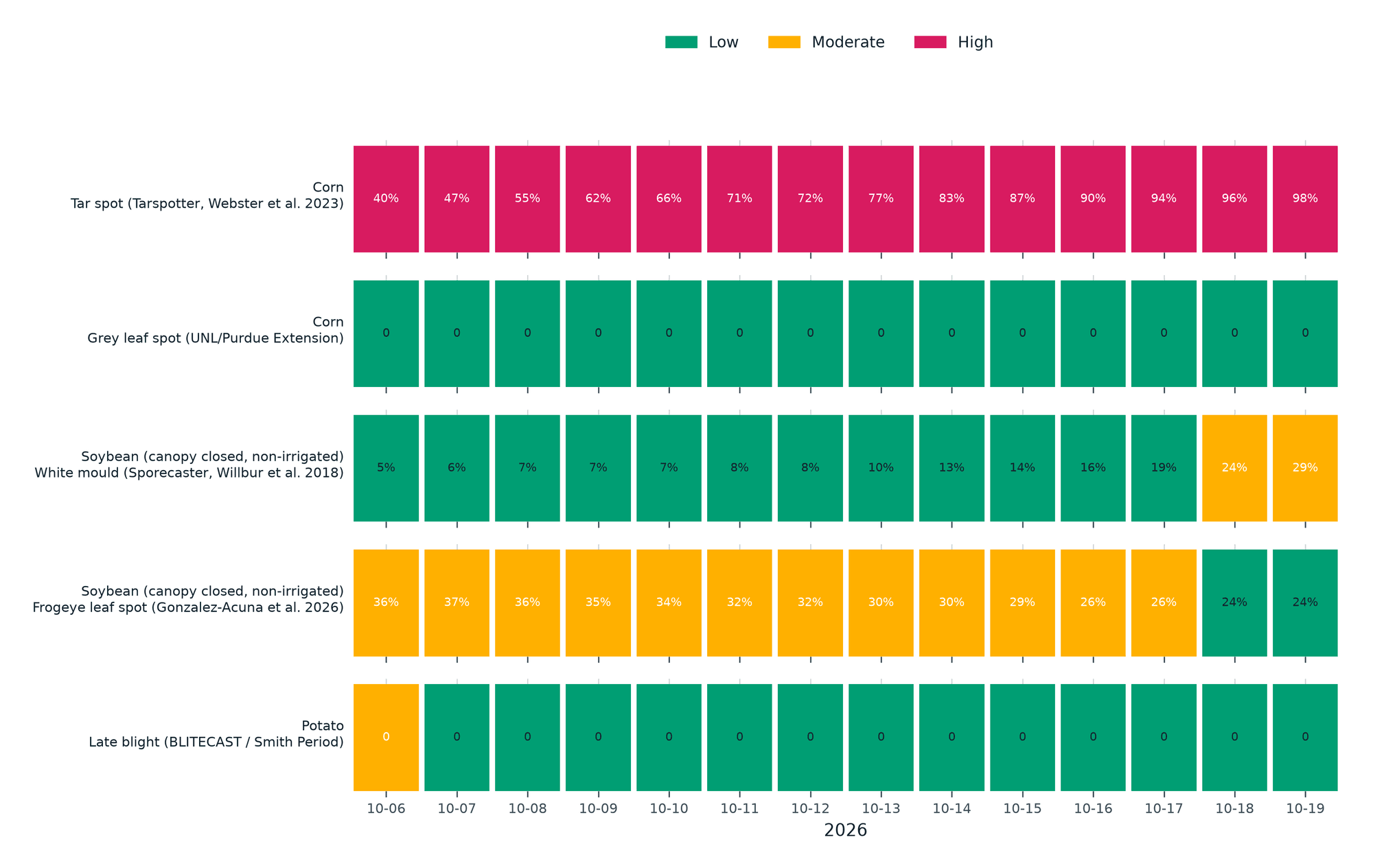
Available on requestForecast disease pressure on a field for each of the next 14 days. Every model is a published one, run on the field’s own weather forecast and the trailing weather it requires. Each day is classed low, moderate, or high per disease, as defined by the model’s own paper. Each implementation is checked against its paper’s equations on known inputs.
Built for retail agronomy leads and crop consultants deciding what to scout and when.
Core Capabilities
Two-Week Horizon
A daily class for each disease over the next 14 days directs scouting to the fields under pressure.
Published Models
Every model is a published one and is cited in the report.
Field-Level Weather
Each model runs on the field’s own forecast and the trailing weather its paper requires.
What It Looks Like
Inputs and Deliverables
Inputs Required
- Field boundary (drawn on the map, uploaded, or selected from your register).
- The crop, with the crop stage where the model requires it.
Deliverables
- Daily class of low, moderate, or high for each disease across 14 days.
- One panel per disease.
- PDF report citing every model used.
Methodology and Sources
Public Sources: Weather forecast (Open-Meteo), Published disease models.
Limits of Detection
Each class reflects the weather conditions a published model describes. Disease presence in the field is confirmed by scouting.
Every model is cited in the report: Tarspotter for tar spot, Sporecaster for white mould, BLITECAST and the Smith Period for late blight, and published models for grey leaf spot, frogeye leaf spot, Fusarium head blight, and apple scab.
Crops covered are corn, soybean, wheat, potato, and apple.
Workflow
Submit the Field
Draw or upload the field, or select one already on the register.
Name the Crop
Specify the crop, with the crop stage where a model requires it.
Model Run
Every model for that crop runs on the field’s forecast and recent weather.
Delivery
You receive one panel per disease with a class for each of the next 14 days, and the PDF report.
Use Cases
Retail Agronomy Teams
Send scouts first to the growers’ fields where disease pressure is rising this week.
Crop Consultants
Review the two-week outlook for tar spot or white mould before a client call, with the cited model in hand.
Growers
See daily classes for your own fields beside the weekly record, under your adviser’s brand.
Related Solutions
Agroclimatic Report
Summarise a season on one page: heat units, rain, frost and heat days, drought, and soil moisture against normal.
Scouting App
Carry the field register on a phone, with weekly status, tasks, and photos pinned to the field, online or offline.
Season Analytics
Stage every field by degree days, set the season against earlier ones, and list the fields to visit first.
Submit Twenty Fields
Provide twenty field boundaries. The record is delivered within 48 hours as a PDF with the map layers, and the rest of your book can then run under your own name.