Asset Status Check
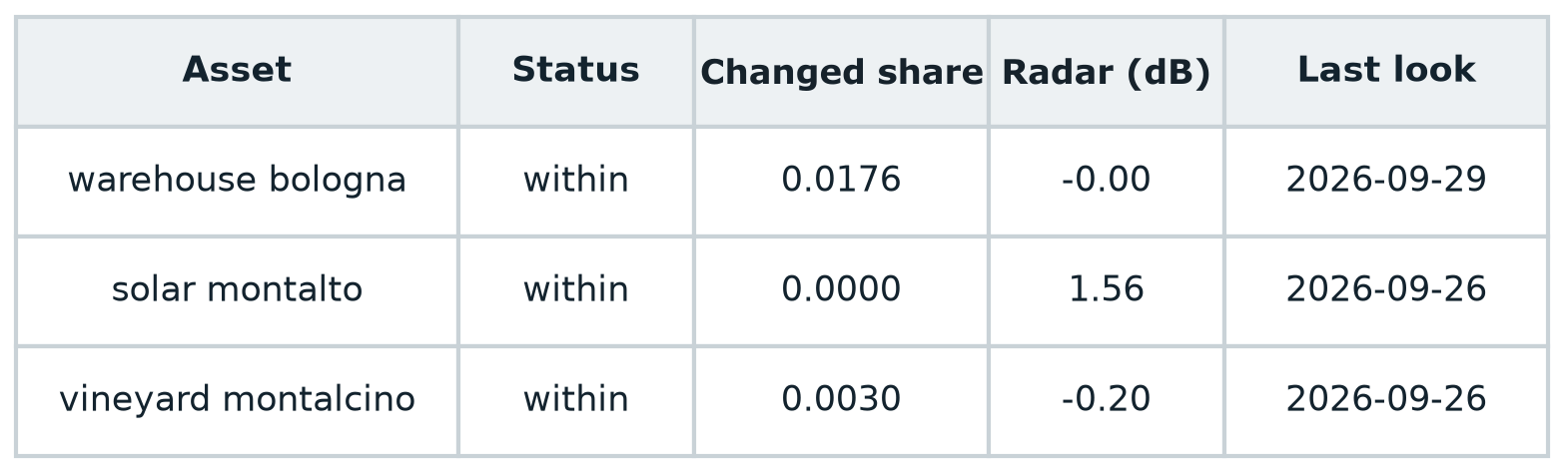
Available on requestClassify every asset in a book as within or above its own quiet range. Each asset is measured against the same seasonal window in each of its previous three years, ensuring a vineyard and a warehouse roof are judged by their own history rather than a single rule. Sentinel-1 radar is reported beside each optical read as a second, cloud-independent measurement. Reviewers receive a short list of the sites that moved.
Built for underwriters, portfolio managers, and risk managers at insurers and lenders reviewing a book of insured or financed sites.
Core Capabilities
Own-History Baseline
Each asset is measured against its own previous three years, not a single rule for the whole book.
Prioritised Review
Assets above their quiet range rise to the top of the list for review.
Persistent Register
Every run updates the same rows under your reference, building each asset’s history.
What It Looks Like
Inputs and Deliverables
Inputs Required
- Asset list (GeoJSON, zipped shapefile, KML, or a CSV of points), with your own reference on each asset.
- Asset type for each site, if it should be printed on the record (building, site, fleet yard, or other).
Deliverables
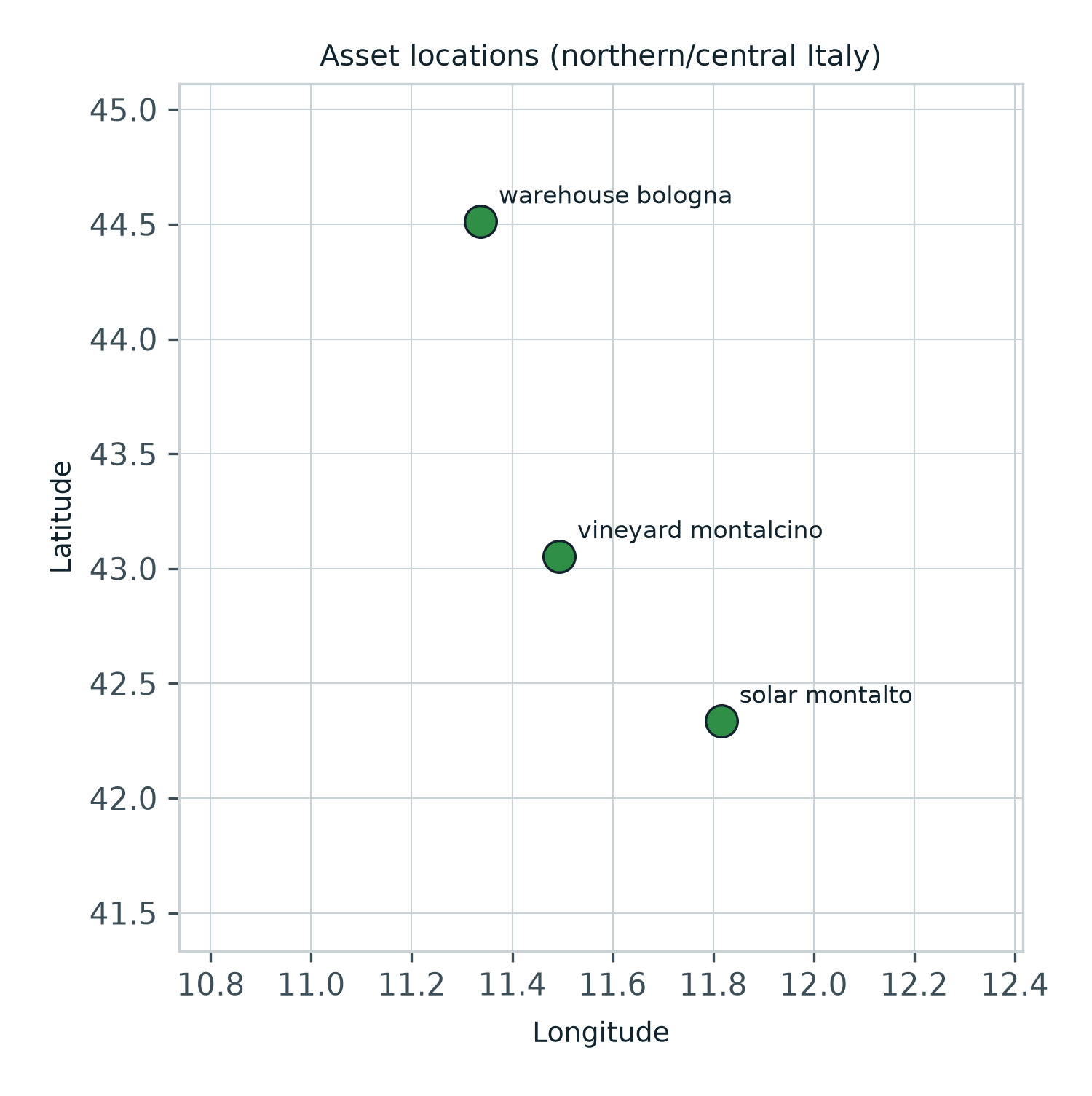
- Map layer marking every asset as within its quiet range, above it, or not read in this run.
- PDF table listing your reference, area, status, and the date of the last clear scene for each asset.
- Archive dates of high-resolution scenes from our partner SkyFi for assets under one hectare.
- Asset register that retains each site’s history, so the next run updates the same rows.
Methodology and Sources
Public Sources: Copernicus Sentinel-2, Copernicus Sentinel-1.
Commercial Sources: High-resolution imagery via our partner SkyFi (on request).
Limits of Detection
The status measures the magnitude of surface change, not its cause. Building interiors and structural condition are not assessed.
Built-up and vegetation change is measured from Sentinel-2 over a recent window and compared with the same window in each of the asset’s previous three years. The quiet range is derived from each asset’s own seasonal behaviour.
For small assets, the record lists the high-resolution archive scenes available over the site, so a closer look can be ordered via our partner SkyFi where it matters.
Workflow
Upload the Book
Provide one asset or a full book, with your own reference on each.
Baseline Comparison
Each asset’s recent window is compared with the same window in its previous three years.
Status Assignment
Every asset is marked within its quiet range, above it, or not read in this run.
Delivery
You receive the status map layer, the PDF table, and the updated register.
Use Cases
Underwriters
Identify insured sites that changed since the last review before a renewal.
Portfolio and Risk Managers
Run the full book each quarter and pass reviewers a short, dated list.
Lenders
Confirm that the site behind a loan matches its condition at origination.
Measured Results
Each figure is printed with its denominator and scope in the paper it links to.
- 3 of 3
- assets in an Italian test portfolio, a warehouse, a solar farm and a vineyard, read within their own quiet range, with the same figures on a repeat read
Related Solutions
Portfolio Monitoring
Track a registered book in one view, with the latest flood, fire, forest and site records and changed assets first.
Climate Risk Scan
Classify every asset in a book across seven hazards, from decades of weather records and public hazard archives.
Claims Validation
Document a claim parcel before and after the date of loss, with every figure tied to a dated scene.
Submit Ten Closed Claims
Provide ten claims from last season that are already settled. Our team reads them back so your adjusters can set the record beside their own findings.