斑岩铜金矿定向
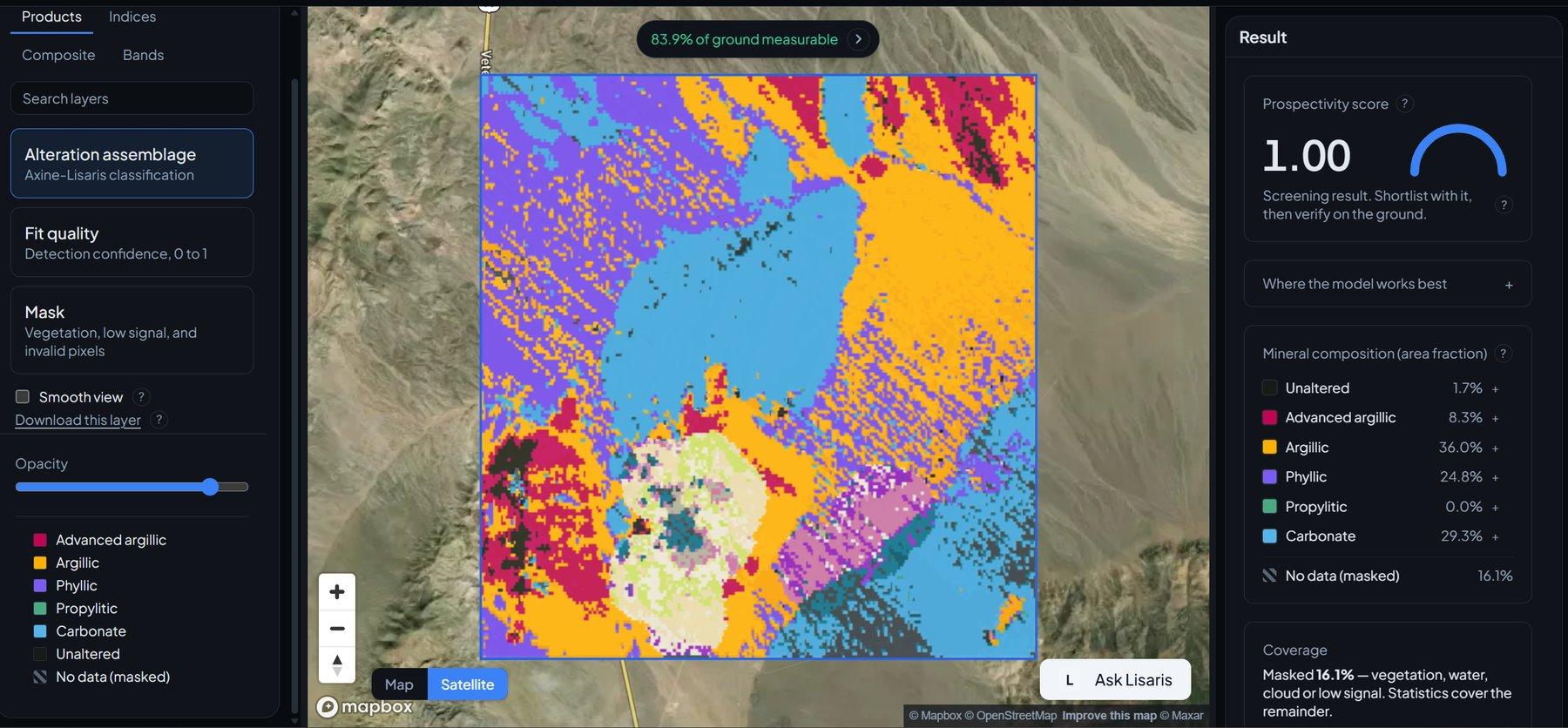
白云母成分以梯度形式成图,从系统中心直到边缘。
通过追踪白云母成分在矿区内的变化,向热液中心定向。

Vectoring gradient across the district, from muscovite at the centre grading to phengite on the fringe.
传感器看到什么
这个图层在寻找什么。
每种材料的实验室参考光谱,以及传感器波段间隔能捕捉到的部分。阴影区标示方法读取的范围。
它能发现什么
它检测什么。
| 材料 | 典型产出环境 | 可能的混淆因素 |
|---|---|---|
| White Mica Compositional Continuum | Porphyry Cu-Au and Cu-Mo phyllic alteration envelopes | Kaolinite doublet masking sericite shoulder |
方法
工作原理。
输入校准反射率,每个像元都对照公开参考库进行拟合。
Polynomial fitting of the absorption minimum
The absorption minimum is fitted across neighbouring channels. Precision follows from how deep the feature is, so it is reported per pixel rather than quoted as a single figure.
Depth gate before position is trusted
The shift being measured is small, so it can only be told from noise where the absorption is deep enough. Shallower pixels are dropped rather than vectored.
Gradient mapping
Computes spatial gradients pointing toward the shorter-wavelength, higher-temperature end of the mica series.
Evaluability masking
Unaltered host rock and pixels with too little white mica are excluded and marked, not filled in.
技术规格
您得到什么,它在什么数据上运行。
所需环境条件
Method and checks are documented in Axine Applied Spectroscopy Paper #1 · Section 9.1.
适用边界
Needs continuous white mica alteration and a strong signal. Weak ground is refused rather than vectored.